Use ← and → to navigate
Swipe left / right on mobile
Guide Notes & Explanation
Accompanying breakdown for this slide deck
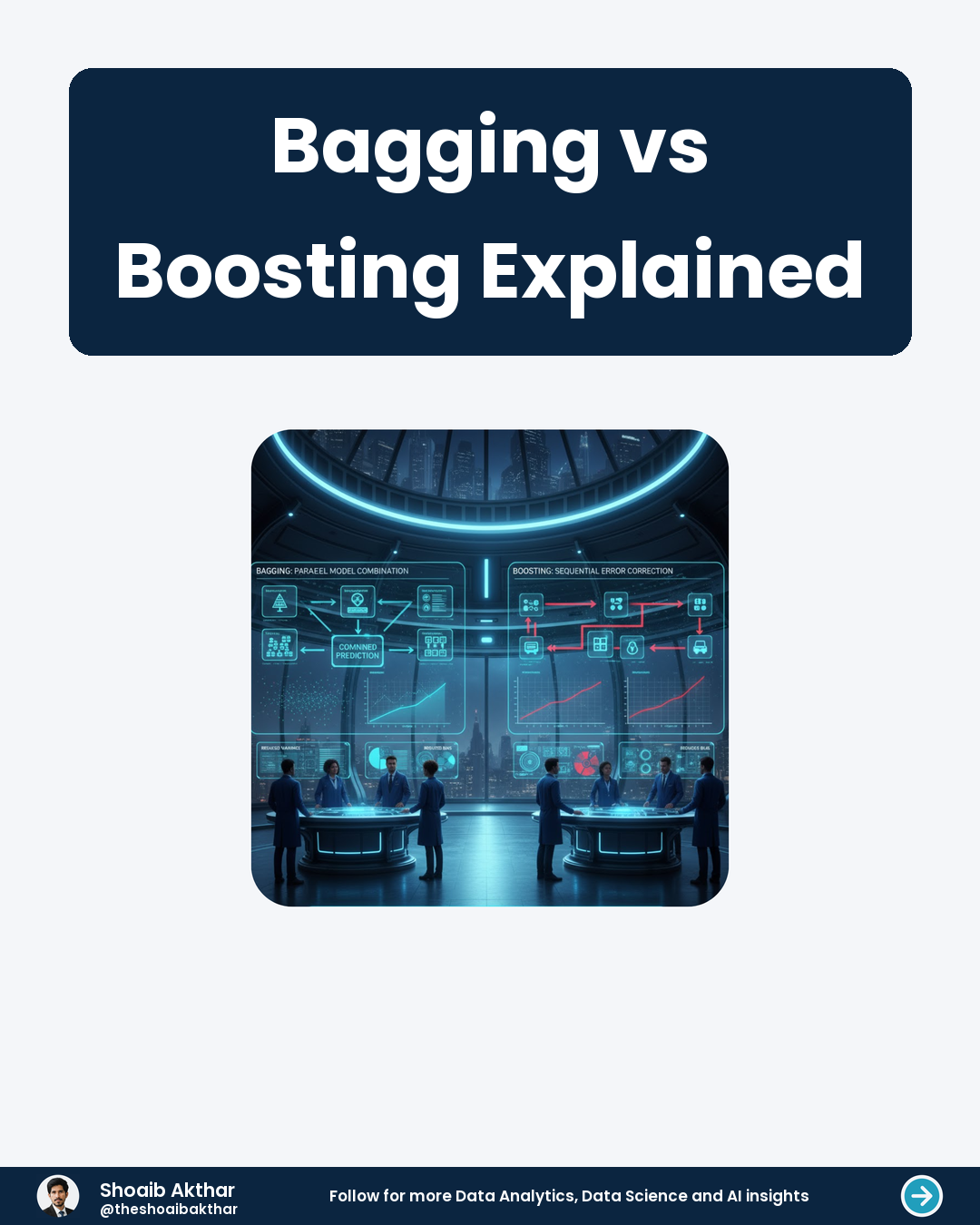
- Bagging vs Boosting Explained
What is Bagging
- Bagging stands for Bootstrap Aggregating
- It combines multiple models to reduce variance
- Works by training models on different subsets of data
- Each model makes predictions independently
- Final prediction is an average of all models
- Reduces overfitting by diversifying data samples
How Bagging Works
- Random subsets of data are created with replacement
- Each subset trains a separate model
- Models are typically decision trees
- Predictions are combined for final output
- Example: Random Forest uses bagging
- Works well with high-variance models
What is Boosting
- Boosting combines weak learners into a strong model
- Models are trained sequentially
- Each new model corrects errors of previous ones
- Focuses on misclassified instances
- Example: AdaBoost, Gradient Boosting
- Reduces bias by focusing on hard cases
How Boosting Works
- First model is trained on the full dataset
- Errors are identified and weighted higher
- Next model focuses more on these errors
- Process repeats for a set number of models
- Final prediction is a weighted vote
- Requires careful tuning of learning rate
Key Differences
- Bagging trains models in parallel
- Boosting trains models sequentially
- Bagging reduces variance
- Boosting reduces bias
- Bagging is more robust to outliers
- Boosting can overfit if not controlled
When to Use Bagging
- When dataset is large and noisy
- When models have high variance
- For tasks requiring stability
- When parallel processing is available
- Example: Random Forest for classification
- Works well with decision trees
When to Use Boosting
- When dataset is small and clean
- When models have high bias
- For tasks needing high accuracy
- When interpretability is important
- Example: XGBoost for structured data
- Requires careful hyperparameter tuning
Summary
- Bagging reduces variance by averaging
- Boosting reduces bias by focusing on errors
- Bagging is parallel, Boosting is sequential
- Choose based on data size and model needs
- Both improve model performance
- Experiment to find the best fit
Previous Resource
Ace Your Next Data Analyst Interview With SQL
Next Resource Beyond One Split Mastering Cross-Validation
Client Service
Want custom technical carousels like this?
Through CaaS (Carousel as a Service), I research, write, and design high-retention 4:5 LinkedIn slide decks and PDFs for creators, founders, and tech teams.