Back to Home
Machine Learning 10 Slides
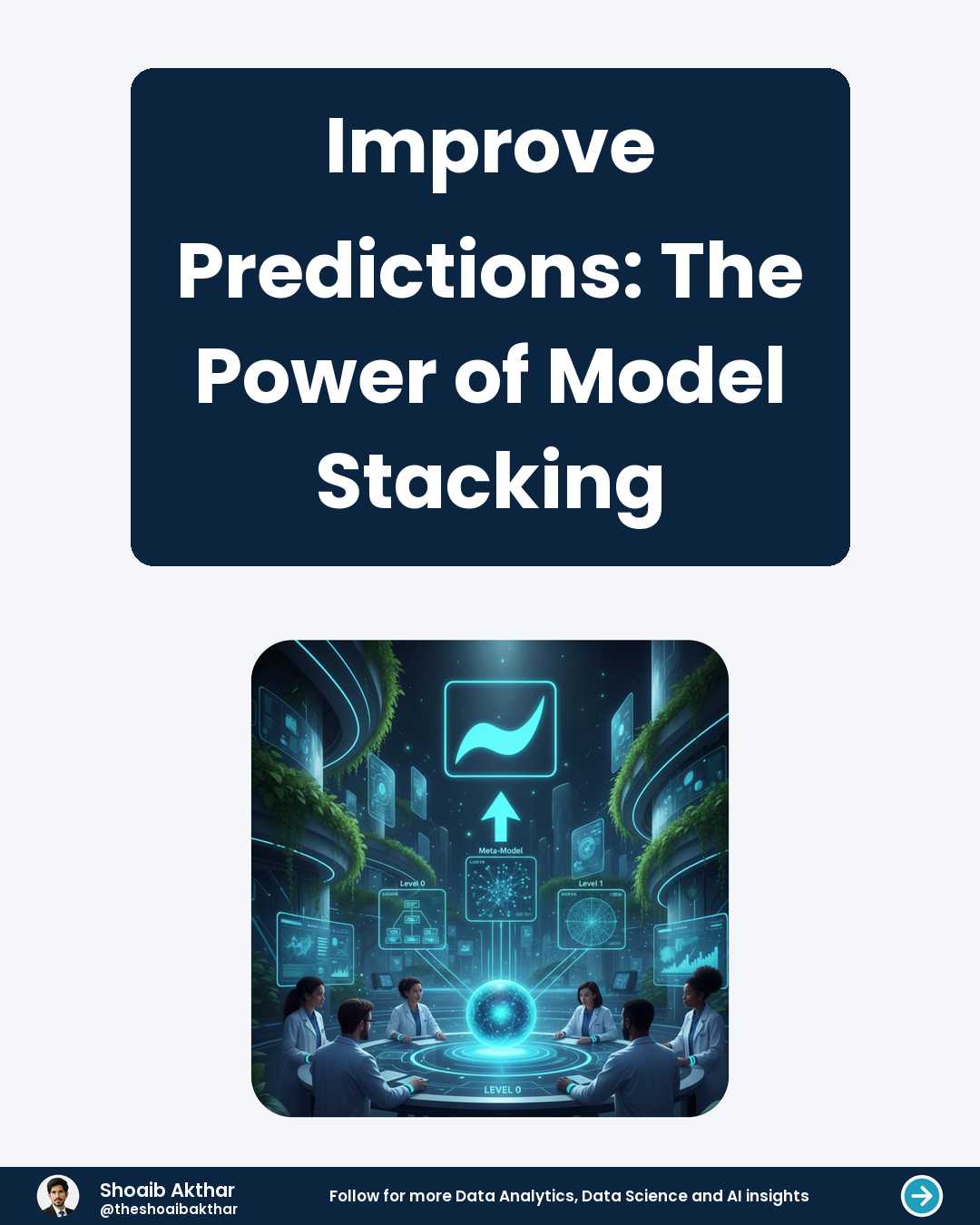
Improve Predictions The Power of Model Stacking.
Use ← and → to navigate
Swipe left / right on mobile
Guide Notes & Explanation
Accompanying breakdown for this slide deck
- Improve Predictions: The Power of Model Stacking
Why Stack Models?
- Model stacking combines the strengths of multiple machine learning models. It addresses limitations of individual models by leveraging their diverse approaches to problem-solving. This technique often leads to more robust and accurate predictions than relying on a single model alone.
- It’s a powerful approach because different models excel at different aspects of prediction. One model might be great at identifying trends, while another is better at handling outliers. Stacking allows us to combine these advantages for improved performance.
- Think of it like a team – each member brings unique skills that contribute to the overall success. Model stacking is similar, where each model provides a different perspective on the data.
The Stacking Process
- The fundamental steps in model stacking involve training base models first. Then, a "meta-learner" model is trained to learn how to combine the outputs of these base models.
- The meta-learner takes the predictions from the base models as input features. This allows it to learn the optimal way to weigh and combine these predictions to arrive at a final, more accurate prediction.
- Essentially, the meta-learner learns to "smartly" combine the insights from the base models. This process is often automated using software libraries.
Base Model Variety
- What can be base models? A wide range of algorithms fit the bill! Examples include logistic regression, decision trees, random forests, and gradient boosting machines.
- Each of these models has different characteristics and strengths. Some are good at handling linear relationships, while others can capture complex non-linear patterns. The best choice depends on the nature of your data and the problem you're trying to solve.
- Trying different types of base models is crucial for effective stacking. It's an iterative process of experimentation and refinement.
Meta-Learner Choice
- The meta-learner itself can be any machine learning model. Commonly used options are logistic regression, support vector machines, and even simpler models like linear regression.
- The meta-learner's choice significantly impacts the performance of the stacked model. It needs to be capable of learning the relationships between the predictions of the base models.
- Experimenting with different meta-learners is key to finding the optimal combination for your specific application.
Training the Meta-Learner
- Training the meta-learner requires a representative dataset. It analyzes the predictions of the base models to learn the best way to combine them.
- The performance of the meta-learner is evaluated using appropriate metrics like accuracy, precision, and recall. This allows you to assess the effectiveness of the stacking approach.
- Proper validation and testing are essential to ensure the meta-learner generalizes well to unseen data.
Advantages of Stacking
- Stacking offers several benefits. It often improves prediction accuracy compared to using single models alone. It also enhances robustness and reduces the risk of overfitting.
- Furthermore, stacking can handle complex datasets and challenging prediction problems. The diversity of base models helps to mitigate the impact of noise and outliers.
- This makes stacked models more reliable and adaptable to changing data patterns.
Limitations to Consider
- Stacking isn't a magic bullet. It requires careful planning and tuning. The complexity of the stacking process can increase development time and computational resources needed.
- Selecting the right base models and meta-learner is critical. Poor choices can negate the benefits of stacking.
- Effective implementation involves careful experimentation and validation.
Start Stacking Today!
- Model stacking is a powerful technique for improving predictions. It's a valuable tool for data scientists and machine learning engineers.
- Experiment with different base models, meta-learners, and hyperparameter settings to find the optimal combination for your needs. Don't hesitate to research and learn about best practices in model stacking.
- Explore relevant libraries and frameworks like scikit-learn in Python to simplify the process. Happy stacking!
Previous Resource
How Machines Actually Learn A Simple Guide
Next Resource Is Your Data Holding You Back Clean It Up
Client Service
Want custom technical carousels like this?
Through CaaS (Carousel as a Service), I research, write, and design high-retention 4:5 LinkedIn slide decks and PDFs for creators, founders, and tech teams.