Back to Home
Machine Learning 10 Slides
Support Vector Machines — The Art of Perfect Separation.
Use ← and → to navigate
Swipe left / right on mobile
Guide Notes & Explanation
Accompanying breakdown for this slide deck
- Support Vector Machines — The Art of Perfect Separation
The Core Idea
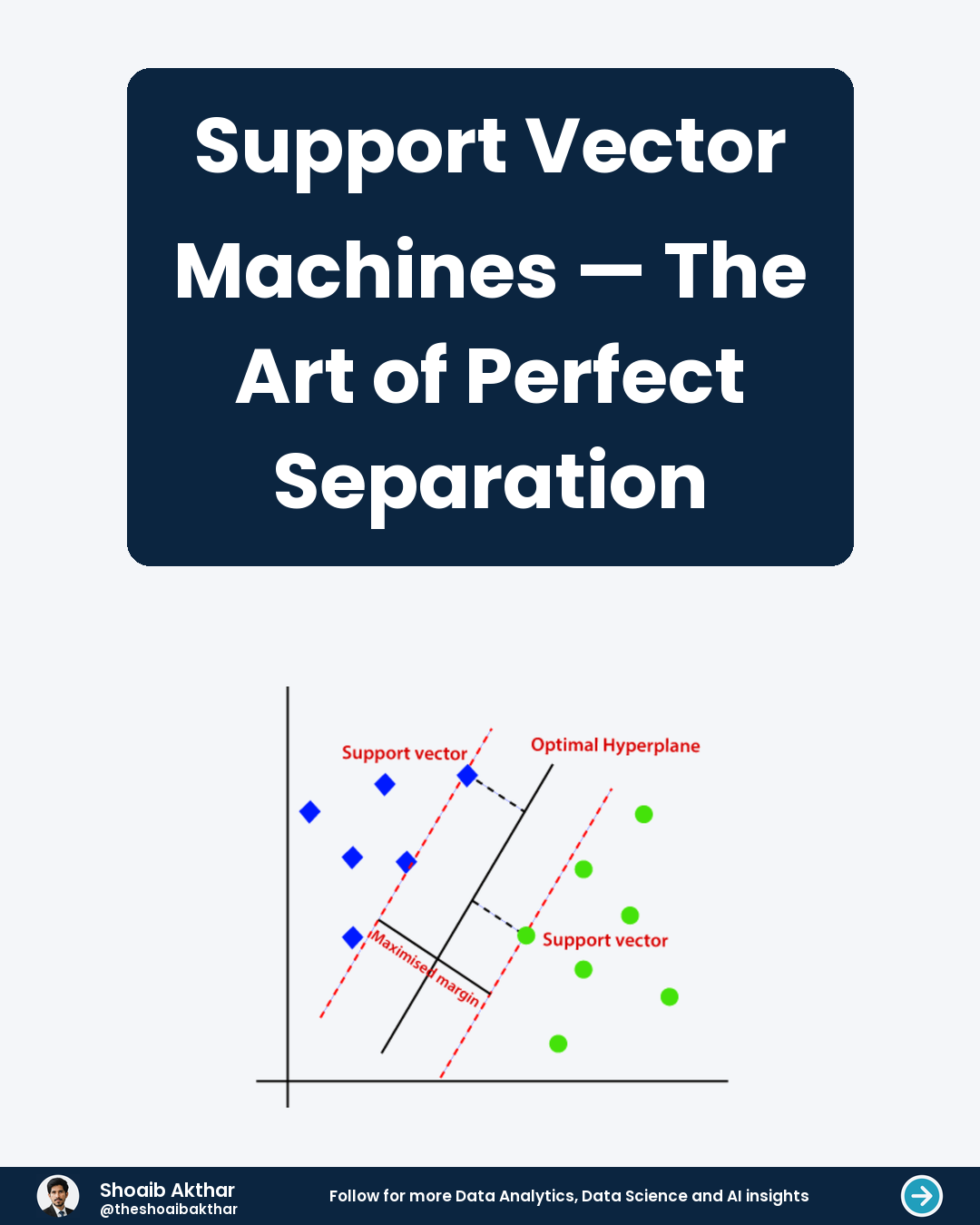
- Imagine you have two distinct groups of data points on a graph. Your goal is to draw a line that best separates them. This is the fundamental task of classification, and Support Vector Machines are masters at it.
- They don't just draw any separating line. They search for the one that creates the widest possible "street" between the groups. This street is called the margin, and its width is crucial for the model's performance.
- The data points that define the edges of this margin are the most important. They are called Support Vectors, and they literally "support" the decision boundary. The entire model is built upon these key points.
Maximizing the Margin
- The optimal separating line is the one that maximizes the distance to the nearest data point from either class. This distance is the margin. A larger margin generally leads to a better and more robust model.
- Think of it as building the widest possible buffer zone between two opposing territories. This buffer helps the model generalize well to new, unseen data because it allows for some uncertainty.
- If a new data point falls within this margin, the model can still make a confident prediction. The maximization of this margin is what makes SVMs so effective and unique among classifiers.
The Hard Margin
- In a perfect, linearly separable world, we can draw a margin that has no data points inside it. This is called a Hard Margin classifier. It insists on perfectly separating all the training data.
- The equations for the decision boundary and the margins are derived from this perfect scenario. The goal is to find the hyperplane that satisfies a strict condition for all data points.
- However, real-world data is often messy. A strict hard margin approach is very sensitive to outliers. A single anomalous point can drastically change the model and make it perform poorly on new data.
The Soft Margin
- To handle messy, overlapping data, we use the Soft Margin. This approach allows some data points to fall inside the margin or even on the wrong side of the decision boundary.
- It introduces a tuning parameter, often called C. This parameter controls the trade-off between having a wide margin and misclassifying some training points. A large C value means you penalize misclassification heavily, leading to a harder margin.
- A small C value allows for more violations, resulting in a wider, softer margin. This flexibility makes SVMs practical for almost any real-world dataset.
Dealing with Non-Linearity
- What if the data cannot be separated by a straight line? SVMs use a clever trick called the "kernel trick" to solve this. They transform the data into a higher-dimensional space where a linear separation becomes possible.
- Imagine tangled data on a 2D plane. By mapping it into 3D, we might find a flat plane that cleanly slices the groups apart. The kernel function performs this mapping without ever explicitly transforming the data, which is computationally efficient.
- Common kernels include the Polynomial Kernel and the Radial Basis Function (RBF) kernel. The RBF kernel is particularly powerful and can handle very complex boundaries.
Kernel Trick Magic
- The kernel is a function that calculates the similarity between two data points in the original space. This similarity is represented as a dot product in the new, high-dimensional space, but we avoid the expensive computation of the transformation itself.
- The math relies on the fact that the SVM optimization only needs the dot products of the data points, not the transformed points themselves. So, we can just use a kernel function K(x_i, x_j) instead of calculating the actual transformation.
- For example, a simple polynomial kernel is K(x_i, x_j) = (x_i . x_j + c)^d. This allows the SVM to find complex polynomial decision boundaries without heavy calculation.
Why Use SVMs?
- SVMs are effective in high-dimensional spaces, even when the number of dimensions is greater than the number of samples. This makes them great for tasks like text classification.
- They are memory efficient since they only use the support vectors to define the model. Once trained, the entire dataset (except the support vectors) can be discarded.
- The kernel trick makes them extremely versatile for non-linear decision boundaries. However, they can be slow to train on very large datasets and require careful tuning of the C and kernel parameters.
Key Takeaways
- SVMs find the optimal separating boundary by maximizing the margin between classes. The support vectors are the critical data points that define this margin.
- The soft margin parameter C allows us to handle imperfect data by balancing margin width and classification errors. This is essential for practical applications.
- For non-linear data, the kernel trick implicitly maps data to a higher dimension to find a linear separator. This powerful technique lets SVMs solve complex problems with elegant efficiency.
Previous Resource
Supercharge Your Data Analysis with Python
Next Resource Surviving the Inevitable AI Market Correction
Client Service
Want custom technical carousels like this?
Through CaaS (Carousel as a Service), I research, write, and design high-retention 4:5 LinkedIn slide decks and PDFs for creators, founders, and tech teams.