Use ← and → to navigate
Swipe left / right on mobile
Guide Notes & Explanation
Accompanying breakdown for this slide deck
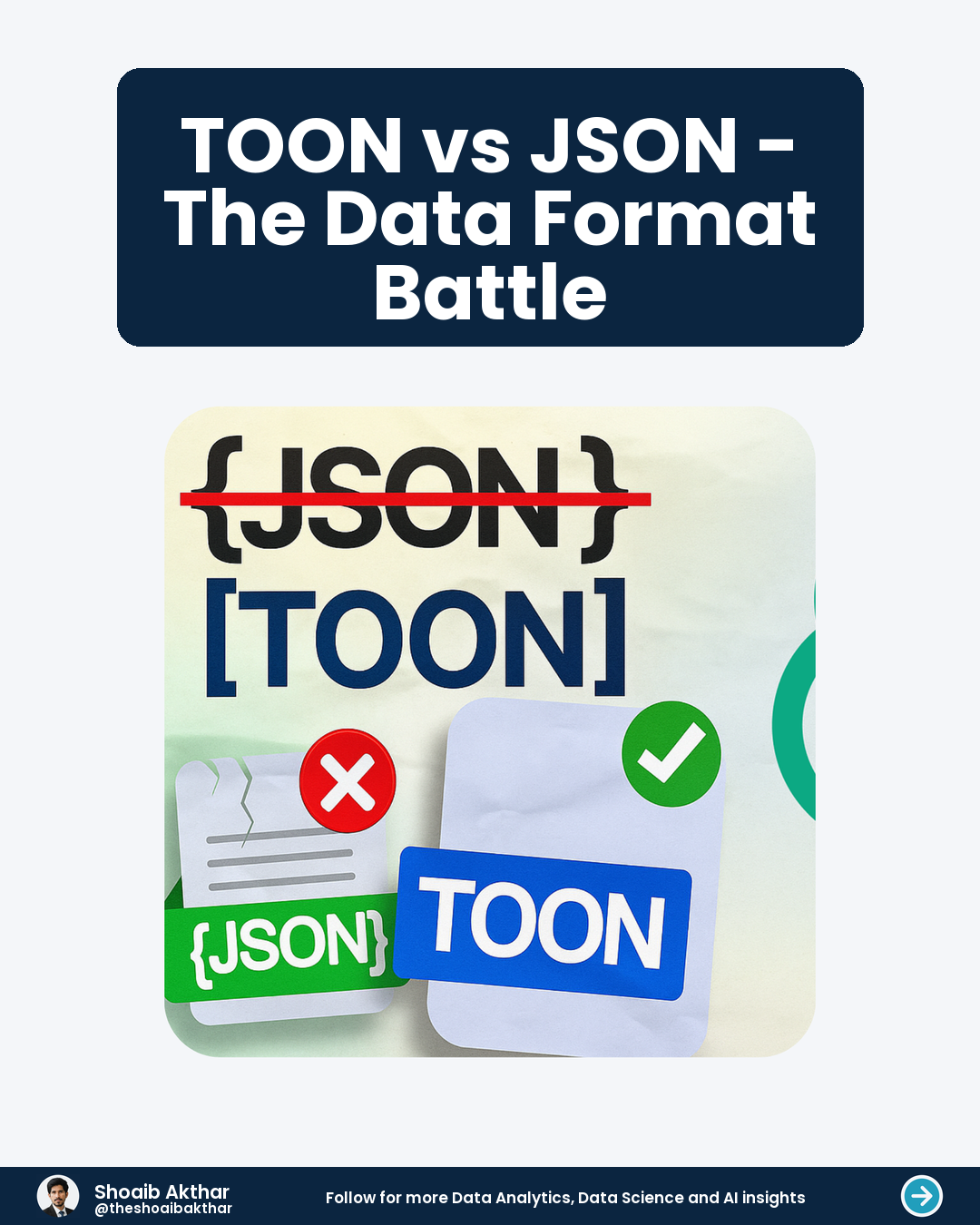
- TOON vs JSON - The Data Format Battle
The Data Formats
- JSON remains the universal standard for transferring data, but struggles with AI-driven workloads.
- TOON is built for large language models (LLMs), aiming to shrink data size for faster AI processing.
- Most developers default to JSON for familiarity and integration ease.
- AI systems now process far larger datasets per request than traditional applications.
- Token efficiency is critical for reducing costs and increasing throughput in AI workflows.
JSON at a Glance
- Human-readable, lightweight syntax with broad support across languages.
- Ideal for deeply nested or varied data types thanks to flexible structure.
- Works perfectly for APIs, backend logs, browser data, and configurations.
- Relies on quotes, braces, and commas — creating more tokens per record.
- Familiar to most engineers, making debugging and collaboration easy.
- Mature ecosystem with validators, utilities, and documentation.
Meet TOON
- Designed specifically for AI, agent comms, and tabular data exchange.
- Syntax uses indentation and headers, resembling spreadsheets for clarity.
- Strips out punctuation to minimize token count — no unnecessary symbols.
- Best suited for large, uniform tabular datasets like user lists or analytics tables.
- Typically uses 30–60% fewer tokens than JSON in standardized data scenarios.
- Ecosystem is growing, with libraries for Python, JavaScript, and Go.
Syntax Side-by-Side
- TOON’s headers define field names once; JSON repeats them with every record.
- Example: TOON is “id,name: 1,Alice,” while JSON is “{‘id’: 1, ‘name’: ‘Alice’}”.
- TOON offers cleaner, easier views for uniform or repetitive data; JSON handles nested and irregular data better.
- Less punctuation with TOON means less confusion and quicker scanning.
- Faster parsing and reduced latency are common with TOON-based AI pipelines.
- JSON’s structured tokens stay relevant for tree-like, hierarchical data.
Token Efficiency
- JSON files grow quickly in token count, increasing resource costs.
- TOON consistently shows 35–60% savings on common structured datasets.
- E-commerce use case: TOON shrinks order data by one-third compared to JSON.
- Tabular arrays (users, transactions, logs) benefit most from TOON’s compactness.
- More data can fit into each LLM prompt, boosting context and accuracy.
- API and model costs drop when using TOON, thanks to fewer input tokens.
Parsing and Accuracy
- LLMs can misinterpret verbose, punctuation-heavy formats like JSON.
- TOON’s layout drives faster, more reliable parsing in AI models.
- Benchmarks show higher success rates coding with TOON over JSON.
- Explicit headers and line structures leave less room for model errors.
- Flat schema data works best with TOON; complex trees still favor JSON.
- Consistent structures improve pass rates and precision in enterprise AI.
Use Cases
- JSON is perfect for generic REST APIs, web projects, and nested config files.
- TOON is ideal for AI prompts, document chunking, and batch data loads.
- Retrieval-augmented generation (RAG) and data agent pipelines favor TOON’s efficiency.
- JSON’s universal maturity translates to broad tooling and IDE support.
- TOON’s toolset is expanding, making it easier for LLM and agent integrations.
- Many teams use both: JSON for legacy, TOON for new LLM-centric systems.
Drawbacks
- TOON isn’t designed for complex, nested hierarchies or highly irregular data sets.
- Web and API standards don’t yet fully support TOON; integration may require custom tools.
- Formatting errors (like bad indentation) can break pipelines if not handled.
- Smaller language models sometimes deliver more predictable results with JSON.
- Always test accuracy and reliability before switching mission-critical data flows.
- Mixed-format support will likely be needed as both formats coexist.
Real-World Impact
- Enterprises see reduced API costs and faster turnaround times using TOON for AI workflows.
- Data teams can fit much more information per LLM context window.
- Precision increases for AI-driven retrieval and document chunking tasks.
- Model pass rates improve when input matches the data format LLMs are trained with.
- Hybrid workflows combine JSON legacy modules with TOON for AI pipelines.
- Expect more formats and ecosystems as AI matures and data needs evolve.
Future of Data Formats
- Token-efficient formats like TOON mark a major shift for AI engineering needs.
- JSON will remain a staple due to its compatibility and maturity.
- Savvy developers choose data formats based on project goals, not trends.
- Expect hybrids, adaptive engines, and smarter parsing as new formats emerge.
- Skills in both TOON and JSON are valuable in the rapidly-shifting AI landscape.
- Choosing the right format is key to building efficient, resilient, and scalable AI systems.
Previous Resource
Tools and Tool Calling in Agentic AI
Next Resource Top 10 Concepts You Must Know in Power BI
Client Service
Want custom technical carousels like this?
Through CaaS (Carousel as a Service), I research, write, and design high-retention 4:5 LinkedIn slide decks and PDFs for creators, founders, and tech teams.