Use ← and → to navigate
Swipe left / right on mobile
Guide Notes & Explanation
Accompanying breakdown for this slide deck
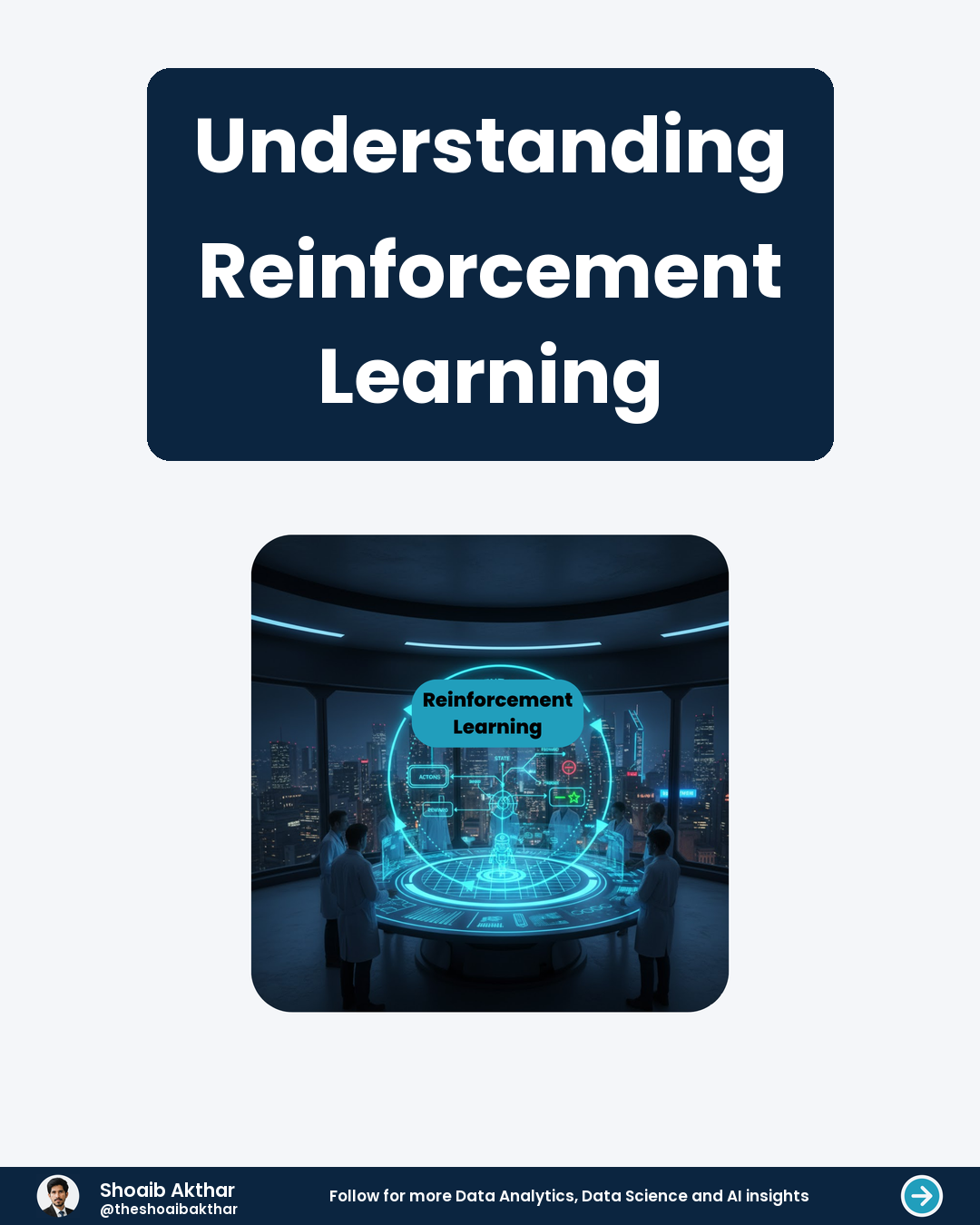
- Understanding Reinforcement Learning
What is RL?
- Reinforcement Learning is a type of machine learning.
- It focuses on training agents to make decisions in an environment.
- The agent learns by interacting with the environment.
- The goal is to maximize a reward signal.
- It's about trial and error to find the best strategy.
Key Components
- Agent: The learner or decision-maker.
- Environment: The world the agent interacts with.
- Actions: What the agent can do.
- State: The current situation of the environment.
- Reward: Feedback the agent receives after an action.
- Policy: The strategy the agent uses to choose actions.
The Learning Process
- The agent observes the current state of the environment.
- It selects an action based on its current policy.
- It receives a reward (positive or negative).
- The agent updates its policy based on the reward.
- This happens repeatedly over many interactions.
Reward Signals
- Rewards can be positive (encouraging behavior).
- Rewards can be negative (discouraging behavior).
- The reward signal guides the agent's learning.
- Careful design of rewards is crucial.
Exploration vs. Exploitation
- Exploration: Trying new actions to discover better strategies.
- Exploitation: Using the current best policy to maximize rewards.
- Balancing exploration and exploitation is important.
- Too much exploration can waste time.
- Too much exploitation can get stuck in local optima.
Common Algorithms
- Q-Learning: Learns a value function for each state-action pair.
- SARSA: Uses the current policy to determine the next action.
- Deep Q-Networks (DQN): Uses deep neural networks to approximate the Q-function.
- Policy Gradients: Directly optimizes the policy.
Applications of RL
- Game playing (AlphaGo, Atari games).
- Robotics (navigation, manipulation).
- Finance (trading, portfolio optimization).
- Healthcare (treatment planning).
- Recommender systems.
Future of RL
- Continues to be a rapidly growing field.
- Potential for solving complex real-world problems.
- Advancements in algorithms and hardware are driving progress.
- Expect to see more widespread adoption in diverse industries.
Previous Resource
Understanding RAG And Why It Matters
Next Resource Unlock Faster Power BI Performance Now!
Client Service
Want custom technical carousels like this?
Through CaaS (Carousel as a Service), I research, write, and design high-retention 4:5 LinkedIn slide decks and PDFs for creators, founders, and tech teams.