Use ← and → to navigate
Swipe left / right on mobile
Guide Notes & Explanation
Accompanying breakdown for this slide deck
- Logistic Regression: It's Not What You Think
What's In a Name?
- Logistic regression has a confusing name. It contains the word "regression," which typically describes predicting a continuous number. But this algorithm is actually used for classification tasks.
- It predicts which category an observation belongs to. For example, it can classify an email as spam or not spam. It can predict if a transaction is fraudulent or legitimate.
- The name comes from its historical development. It uses a linear regression-like approach but then transforms its output. This transformation allows it to predict probabilities for categories.
The Core Concept
- At its heart, logistic regression estimates probabilities. It calculates the probability that a given input belongs to a default category. If the probability is above 0.5, it predicts one class; below, it predicts the other.
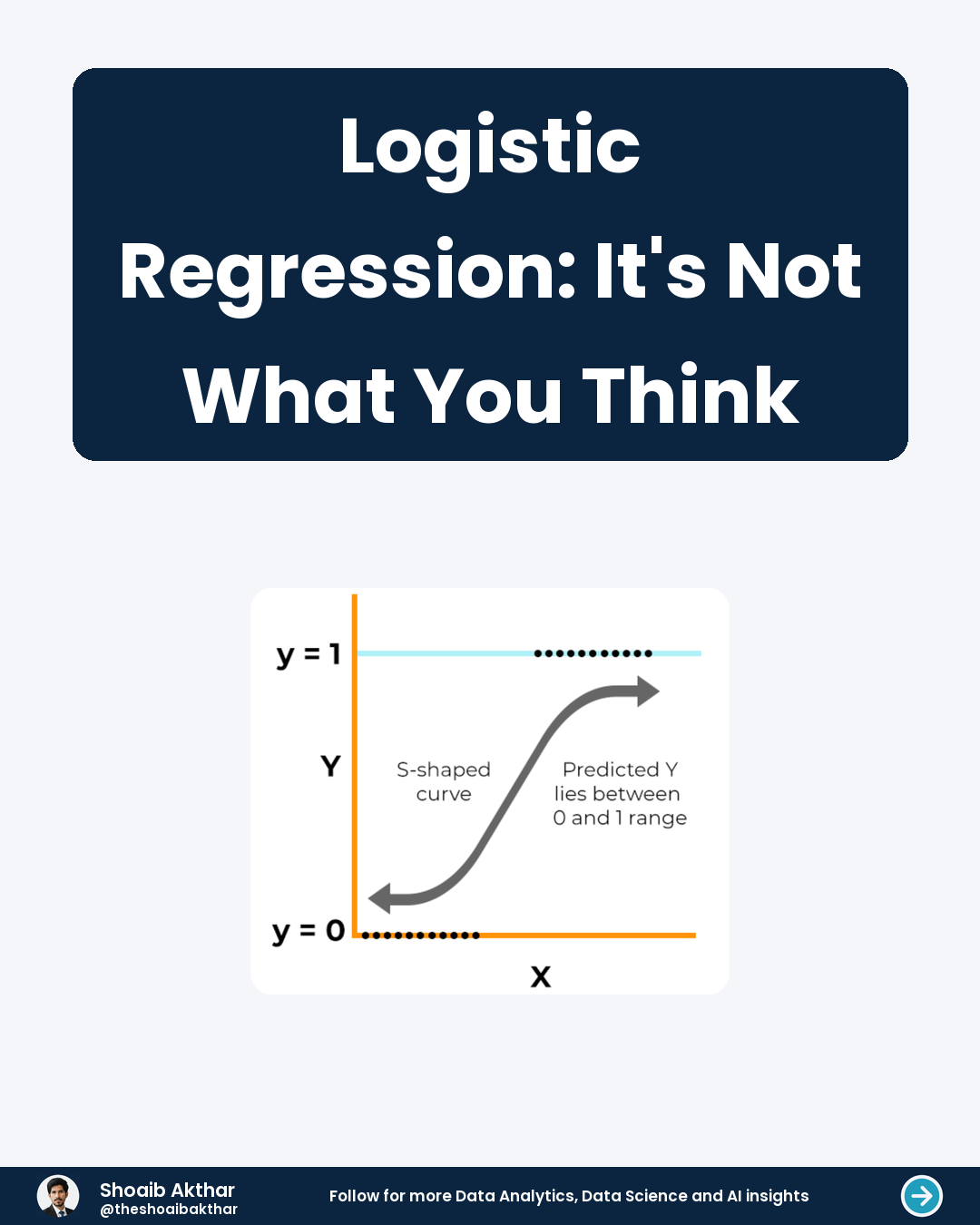
- It does this by using the logistic function. This function, also known as the sigmoid function, takes any real number. It then squashes that number into a value between 0 and 1.
- This output is interpreted as a probability. This simple yet powerful mechanism is the key to its success.
The Sigmoid Function
- The magic happens with the sigmoid function. It is the mathematical engine that enables classification. Its formula is straightforward.
- The equation for the sigmoid function is: P(Y=1) = 1 / (1 + e^(-z))
- Here, 'z' is the linear combination of inputs and coefficients. 'e' is the base of the natural logarithm. The output P(Y=1) is the probability of the event occurring.
- This S-shaped curve is perfect for modeling probabilities. It ensures outputs are always sensible, bounded between 0 and 1.
Making a Decision
- A probability alone is not a classification. We need a clear rule to make a decision. This is where the threshold comes in.
- By default, the threshold is set at 0.5. If the predicted probability is >= 0.5, the outcome is predicted as class 1. If it is < 0.5, the outcome is predicted as class 0.
- This threshold can be adjusted based on business needs. For instance, in medical testing, we might lower the threshold to catch more sick patients.
It's Linear Inside
- Despite being a classifier, it has a linear core. The 'z' in the sigmoid equation is a linear function. It looks just like a linear regression equation.
- z = b0 + b1*x1 + b2*x2 + ... + bn*xn
- The coefficients (b1, b2,...) are learned from the data. They represent the log odds of the outcome. This linear combination is then passed to the nonlinear sigmoid.
- This blend of linear and nonlinear is why it's so effective.
Why So Popular?
- Logistic regression is a fundamental algorithm in machine learning. Its popularity stems from several key advantages. It is fast to train and easy to implement.
- It provides not just a class label, but a probability score. This probabilistic interpretation is incredibly valuable for risk assessment. It also requires less computational power than complex models.
- Furthermore, the coefficients are interpretable. We can understand the impact of each feature on the outcome.
Beyond Binary Problems
- Logistic regression isn't limited to two classes. It can be extended for multiclass classification. This version is called Multinomial Logistic Regression.
- It uses the softmax function instead of the sigmoid function. The softmax function outputs probabilities for each class. The probabilities for all classes sum to one.
- This makes it a versatile tool for various classification challenges. It is a go-to method for many real-world problems.
Real-World Applications
- You encounter logistic regression daily, often without knowing it. Banks use it to assess credit risk and flag fraudulent transactions. It helps determine the likelihood a loan will default.
- Marketing teams use it for customer churn prediction. It identifies users who are likely to stop using a service. Email providers rely on it to filter spam from your inbox.
- Its applications are vast across finance, healthcare, and tech.
A Great First Model
- When starting a classification project, begin with logistic regression. It provides a strong and interpretable baseline performance. You can compare more complex models against it.
- If a complicated model cannot outperform logistic regression, it may be unnecessary. It helps validate the predictive power of your features. It is a benchmark for model performance.
- This makes it an essential first step in any data scientist's workflow.
The Takeaway
- Remember, logistic regression is for classification, not regression. The name is a historical artifact that can be misleading. Its output is a probability that is then used for categorization.
- It is a simple, powerful, and highly interpretable algorithm. It should be a core part of every machine learning toolkit. Do not overlook it in favor of more complex models.
- Understand it, use it, and appreciate its elegance and utility.
Previous Resource
Linear Regression Explained Simply With Real Estate
Next Resource Machine Learning vs. Traditional Programming A New Paradigm
Client Service
Want custom technical carousels like this?
Through CaaS (Carousel as a Service), I research, write, and design high-retention 4:5 LinkedIn slide decks and PDFs for creators, founders, and tech teams.